
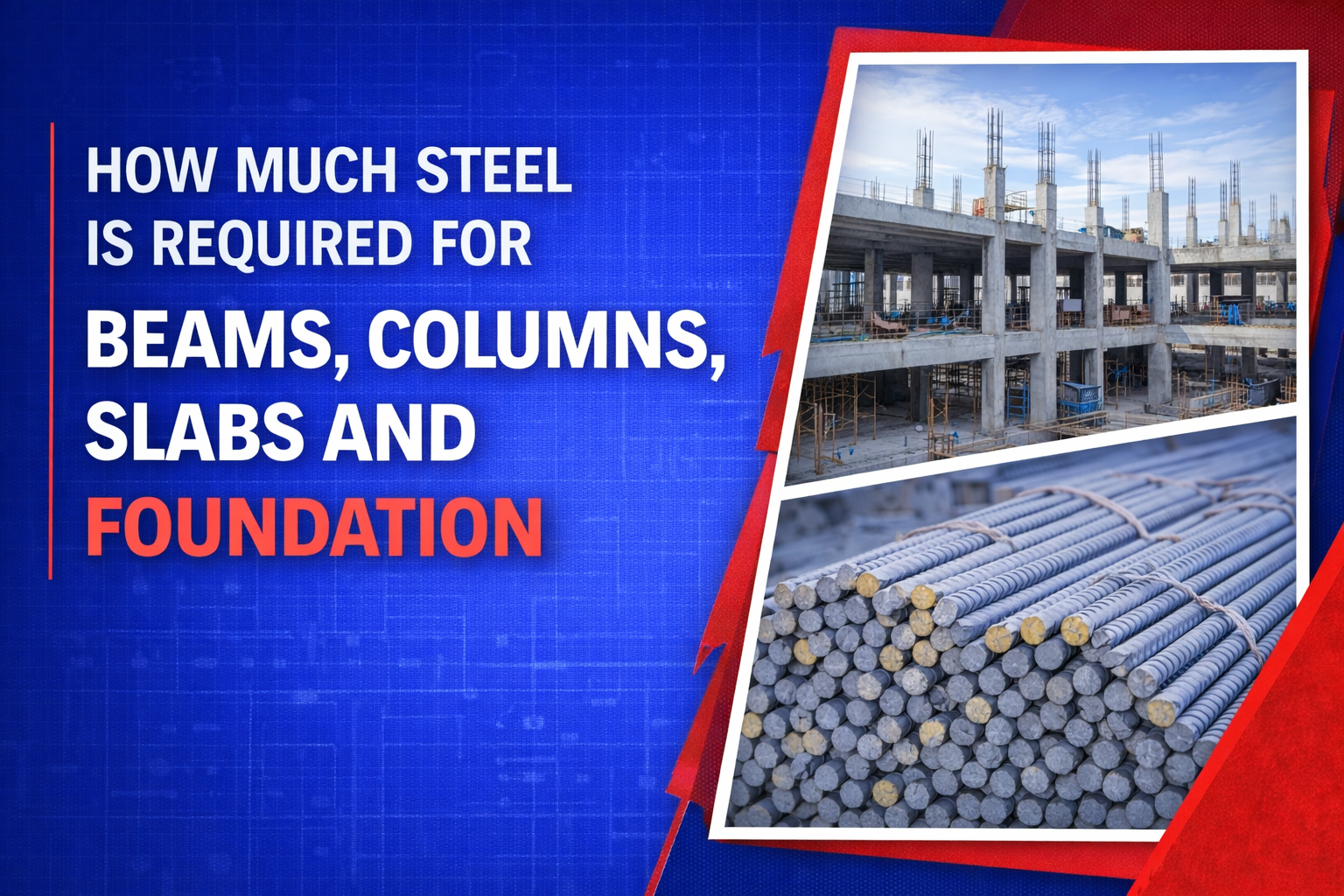
Steel plays a pivotal role in the construction sector, with sizes and types varying across residential, commercial, and industrial segments. However, determining the exact quantity of steel required for different structures needs careful consideration and calculations.
In this blog, we have presented a comprehensive discussion of the types of steel required for beams, columns, slabs, and a building’s foundation, so you can easily navigate the essential aspects of construction.
What is Steel Reinforcement in Construction?
Thermo-Mechanically Treated Bars (TMT) are used in steel reinforcement across modern construction projects. As the best TMT Steel suppliers in Kolkata, we offer 550D graded bars that work in perfect synergy with concrete, providing tensile strength to concrete only.
Proper TMT bar reinforcement can determine how much load your building can withstand, how well it resists earthquakes, and how well it stands the test of time.
Steel required for beams
Beams are horizontal structural members that transfer loads from slabs and walls to columns. Since beams experience bending moments and shear forces, they require a moderate to high amount of steel reinforcement.
Typically, the steel percentage in beams ranges between 1% and 2.5% of the beam’s cross-sectional area. Heavily loaded beams or longer spans may require reinforcement closer to the upper limit.
The TMT Bar is usually placed at the bottom (tension zone) and sometimes at the top, along with stirrups for shear strength. Proper reinforcement ensures durability, crack resistance, and load-bearing efficiency.
Steel required for columns
Columns are vertical load-bearing members that transfer the entire structure’s weight to the foundation. Because they support axial loads as well as bending forces, they require a higher percentage of steel than beams and slabs.
The steel percentage in columns generally ranges between 2% and 4% of the cross-sectional area. As the top supplier of TMT Bars, we ensure that, in high-rise buildings or earthquake-prone zones, reinforcement is placed near the upper limit to enhance safety. Longitudinal bars provide compressive strength. At the same time, lateral ties or stirrups maintain structural stability and prevent buckling.
Steel required for slabs
Slabs form the floors and roofs of buildings and distribute loads to beams and columns. Compared to beams and columns, slabs carry relatively lighter loads and therefore require a lower percentage of steel.
Generally, slab reinforcement ranges from 0.7% to 1.5%. One-way slabs may require reinforcement primarily in one direction, while two-way slabs need reinforcement in both directions. Adequate TMT Bars in slabs help control cracking, manage shrinkage, and maintain structural integrity over time.
Steel required for the foundation
Foundations transfer the structure’s load safely to the soil. The amount of steel required in foundations depends largely on soil bearing capacity, building load, and the type of foundation (isolated footing, raft, pile foundation, etc.).
On average, steel reinforcement in foundations ranges from 0.8% to 2%. Heavier structures or weaker soil conditions may require higher reinforcement. Proper placement of our Pure TMT Bars ensures the foundation effectively resists bending, shear, and settlement forces.
How to Calculate Steel Quantity for Construction?
Accurate steel calculations are crucial for ensuring structural integrity and cost-effectiveness. Professional structural engineers use advanced software and technologies to calculate the steel quantities required for various structural needs accurately.
The following are the basic approaches to calculating steel quantity for construction:
- Determine the concrete volume for the structural element (beam, slab, foundation, column).
- Based on design requirements, apply the appropriate steel percentage.
- Calculate the volume of the steel (Volume of Concrete x Steel Percentage).
- Convert to weight: Steel volume × 7850 kg/m³ (density of steel)
Why are Maan Shakti 550D TMT bars essential for strong construction?
The quality of TMT bar reinforcement directly impacts your building’s strength and durability. As the best TMT steel suppliers in Kolkata, here’s how our 550D TMT Bars are essential:
- High-tensile yield strength for maximum load-bearing capacity.
- Better elongation properties to resist seismic shocks.
- Ribbed TMT Bar structures ensure optimal adhesion to concrete and prevent rust formation and degradation.
Conclusion
Calculating the steel required for beams, columns, slabs, and foundations is a critical step in any construction project. Accurate estimation not only ensures structural safety and durability but also helps control costs by minimizing material wastage.
Proper steel quantity calculation allows engineers and contractors to maintain design efficiency while adhering to building standards and specifications. Connect with us for further information.