



TMT Bars and Earthquake Resistance: Why Ductility Matters

Latest Post
-
01
Oct 23, 2026 Best TMT Bar Manufacturers
How to Check Bar Markings, Grade and Quality Certificates Read More

-
02
Oct 23, 2026 TMT Bar for Construction
How Much Rust Is Acceptable on TMT Bars for Construction? Read More
Categories
Popular Tags
- TMT Bars
- tmt
- TMT Bar
- Best TMT Bars
- Top Rated TMT Steel Bar Manufacturers
- Supplier of TMT Bars
- bars
- Manufacturer of TMT Bars
- Superior Quality steel TMT Bars
- TMT Bars Suppliers
- TMT Bars Manufacturers
- Bar
- Best TMT Bar Manufacturers
- Earthquake Resistant TMT Bars
- Thermo Mechanical Treated Steel
- tmt wholesale & distributor in west Bengal
- TMT Steel Suppliers Kolkata
- Pure TMT Bars
- Best
- TMT Bar Manufacturers Kolkata
- Corrosion Resistance TMT Bars
- Top TMT Company Assam
- leading TMT Bar producer
- Company
- Best TMT Steel Manufacturers West Bengal
- Best TMT Bar Company Assam
- TMT Bar West Bengal
- manufacturers
- Leading TMT Bars West Bengal
- TMT Bar Company
- Assam
- Top TMT bar manufacturers in West Bengal
- TMT Wholesale Distributor
- Leading Manufacturer of TMT Bars
- TMT Bar Manufacturer
- Steel
- of
- TMT Steel Bars
- Pure TMT Bars Kolkata
- Leading TMT Bar Producer Assam
- Best TMT Brand Assam
- Kolkata
- Suppliers
- West Bengal
- Construction
- Best TMT Bar
- TMT Bar Manufacturers
- Manufacturer of Tmt Saria Assam
- Top
- Leading
- Industry
- TMT Steel Bar
- Best TMT Steel Manufacturers in West Bengal
- Corrosion Resistant TMT Bars
- TMT Steel Suppliers in Kolkata
- TMT Manufacturer
- Top TMT Bar manufacturers
- leading TMT bar producer in Assam
- Earthquake
- Resistant
- Supplier
- Resistance
- Producer
- Pure
- Manufacturer
- TMT Steel Bar Manufacturers
- tmt wholesale distributors in west bengal
- TMT Bar for Construction
- TMT Rebar
- Pure TMT Bars in Kolkata
- Manufacturing TMT Steel Bars
- TMT Rebars
- Best TMT Bars Manufacturers
- Best TMT Bar Companies in Assam
- TMT Bar Company Assam
- Best TMT Bars Company Assam
- leading TMT Bars Manufacturing Companies Assam
- TMT Bars Suppliers in India
- TMT Bar Wholesale & Distributor
- Corrosion Resistance TMT
- Earthquake Resistant TMT
- Most Popular Brand in TMT Manufacturing
- TMT steel bars suppliers in Kolkata
- leading TMT bar manufacturers
- top-rated TMT bar manufacturers
- TMT Bar Manufacturers in Kolkata
- Fe500D
- sariya
- Quality
- Grades
- TMT Bars Company
- TMT Steel Suppliers
- TMT Wholesale
- TMT Company
- TMT Distributor
- Constructions
- TMT Suppliers
- Leading TMT Bars in West Bengal
- steel TMT bars
- Manufacturer of TMT Saria in Assam
- TMT Bar suppliers
- Best Supplier of TMT bars
- Suppliers of TMT Bars
- Top TMT Companies in Assam
- best TMT Bar manufacturers in West Bengal
- TMT bar producer in Assam
- Steel Bar
- TMT Steel
- corrosion resistant
- top-rated
- Corrosion
- Bars Manufacturer
- Bars TMT
- Bars Best
- Bars Corrosion
- TMT Steel Manufacturers
- Top TMT Bar Manufacturer
- TMT Bars Kolkata
- Earthquake in Kolkata
- Earthquake in Northeast India
- Bulk Order TMT Bar Online
TMT Bars and Earthquake Resistance: Why Ductility Matters
Sep 4, 2026

bluant digital
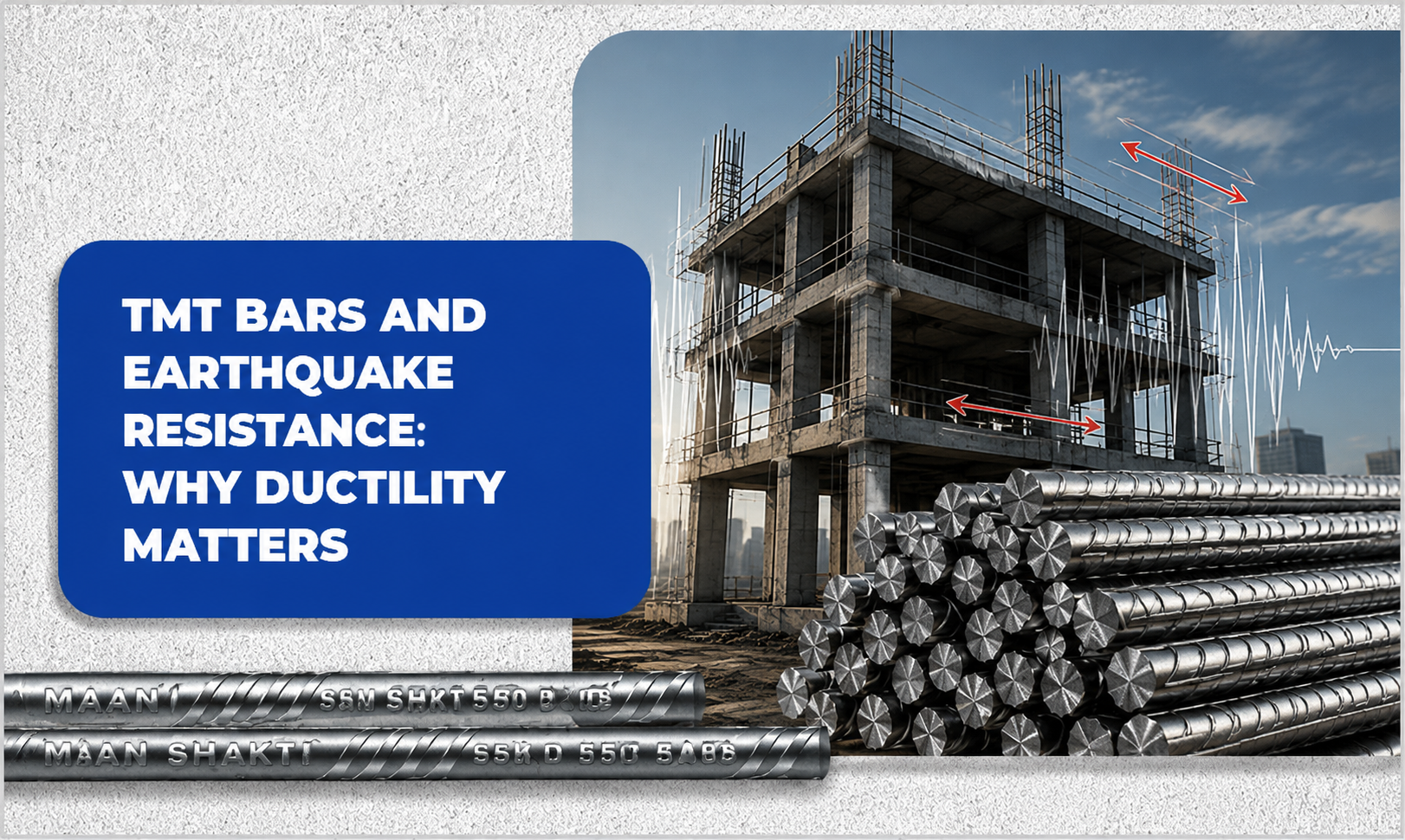
TMT Bars and Earthquake Resistance: Why Ductility Matters
Earthquakes can put enormous and sudden stress on buildings. While concrete provides compressive strength, TMT bars play an important role in providing tensile strength, flexibility and reinforcement to the structure.
But when it comes to earthquake-resistant construction, strength alone is not enough. The ability of reinforcement steel to bend and deform without suddenly breaking is equally important. This property is known as ductility.
For builders, engineers and homeowners, understanding the role of ductility can help in making better decisions when selecting reinforcement steel.
What Is Ductility in TMT Bars?
Ductility is the ability of a material to undergo deformation under stress before failure.
In simple terms, a ductile TMT bar can stretch and bend when subjected to heavy or sudden forces instead of breaking immediately.
This becomes particularly important during an earthquake. Seismic forces can change direction and act suddenly on a building. A reinforcement bar with adequate ductility can undergo controlled deformation and help the structural system absorb and dissipate some of this energy.
The Indian Standard IS 1786 specifies requirements for high-strength deformed steel bars, including strength, elongation, tensile properties, chemical composition and bend performance. The standard specifically distinguishes “D” grades by their enhanced minimum elongation.
Why Is Ductility Important During an Earthquake?
Imagine two materials exposed to the same sudden force.
A brittle material may reach its limit and fail suddenly. A ductile material, on the other hand, can deform before failure.
This difference is extremely important in reinforced concrete structures.
During an earthquake, structural members can experience repeated and rapidly changing loads. Properly designed and detailed reinforcement should allow the structure to undergo controlled deformation rather than experiencing sudden brittle failure.
Therefore, earthquake-resistant construction isn’t simply about choosing the strongest TMT bar. The reinforcement needs an appropriate balance of strength and ductility, along with proper structural design and detailing.
Fe 500 vs Fe 500D: Why Does the “D” Matter?
One of the most important distinctions in TMT grades is the “D” designation.
Under IS 1786, the “D” category indicates enhanced elongation compared with the corresponding standard strength grade. For example, Fe 500D has the same specified minimum yield strength of 500 N/mm² as Fe 500, but a higher minimum elongation requirement.
| Property | Fe 500 | Fe 500D |
| Minimum Yield Strength | 500 N/mm² | 500 N/mm² |
| Minimum Tensile Strength | 545 N/mm² | 565 N/mm² |
| Minimum Elongation | 12% | 16% |
| Minimum UTS/YS Ratio | 1.08 | 1.10 |
These are the IS 1786 minimum requirements shown in the BIS/SAIL specifications.
The key takeaway is that Fe 500D is designed with enhanced ductility while maintaining high strength.
How Does a Ductile TMT Bar Help a Structure?
Ductility can contribute to earthquake-resistant structural behaviour in several ways:
-
Helps Handle Sudden Loads
Earthquake forces can be unpredictable and dynamic. Ductile reinforcement can deform under high stress rather than failing immediately.
-
Allows Controlled Deformation
Instead of sudden fracture, ductile steel can undergo plastic deformation. This allows structural engineers to design buildings that can deform in a controlled manner under severe loading.
-
Helps Absorb and Dissipate Energy
During seismic activity, a ductile structural system can dissipate energy through controlled yielding and deformation. This is one reason ductility is an important consideration in seismic design.
-
Provides Better Bending Performance
Ductility is also reflected in how reinforcement behaves during bending. IS 1786 includes bend and re-bend requirements to assess the performance of reinforcement bars.
Is Higher Strength Always Better for Earthquake Resistance?
Not necessarily.
It can be tempting to assume that a higher-strength TMT bar automatically provides better earthquake resistance. However, seismic performance depends on several factors, including:
- Strength of the reinforcement
- Ductility
- Elongation
- Tensile-to-yield strength relationship
- Chemical composition
- Quality of manufacturing
- Reinforcement detailing
- Concrete quality
- Overall structural design
This is why choosing reinforcement should be based on the requirements of the structural design, rather than simply selecting the bar with the highest strength number.
How TMT Manufacturing Affects Ductility
Ductility isn’t something that can simply be added to a TMT bar after manufacturing. It is influenced by factors such as chemical composition and the thermo-mechanical processing used during production.
Controlled processing helps achieve the required combination of strength and ductility. IS 1786 also places limits on chemical composition and carbon equivalent, which are relevant to properties such as weldability.
This is where the role of a reliable TMT bar manufacturer in India becomes important.
A responsible manufacturer needs to maintain consistency in raw materials, chemical composition, rolling processes, controlled cooling and quality testing so that the finished reinforcement performs consistently with the specified requirements.
What Should You Check When Buying TMT Bars?
Whether you are a homeowner, contractor, builder or project developer, don’t select reinforcement steel based only on price.
Before purchasing, consider:
- Relevant BIS standard
Check whether the TMT bars conform to the applicable requirements of IS 1786. - Grade
Choose the grade specified by your structural engineer for the project. - Mechanical properties
Look at yield strength, tensile strength and elongation. - Chemical composition
Parameters such as carbon, sulphur and phosphorus need to remain within specified limits. - Test certificates
Review the manufacturer’s test documentation and batch information. - Manufacturer consistency
A dependable manufacturer should have proper quality-control systems to maintain consistency across production batches.
Why Choosing the Right TMT Bar Manufacturer Matters
The quality of a building doesn’t depend only on its architectural design. The materials used to create its structural framework matter just as much.
As a TMT bar manufacturer in India, Maan Shakti TMT focuses on producing reinforcement steel with attention to quality, consistency and the required mechanical properties.
For construction projects where structural safety is a priority, choosing properly specified and tested TMT reinforcement is an important part of the overall construction process.
However, the right TMT bar is only one part of earthquake-resistant construction. Structural design, foundation, concrete quality, reinforcement detailing and construction practices must all work together to achieve the desired seismic performance.
Final Thoughts
Earthquake-resistant construction is not simply about making a building stronger. It is about ensuring that the structure can respond to sudden forces in a controlled manner.
That is why ductility matters.
A TMT bar with an appropriate combination of strength and ductility can play an important role in reinforced concrete structures designed for seismic loads. For this reason, builders should look beyond strength numbers and consider the complete mechanical and quality profile of the reinforcement.
-
No tags for this post
Related Blogs


29th Dec 2025

12

0

10th Jun 2025
13
0